Planning Side by Side: Two Comprehensive Plans, Two Distinct Paths, One Deeply Rewarding Experience
WRITTEN BY JENN GOLDSON, AICP
For the past couple of years, our team at JM Goldson has had the unique privilege of working on two local comprehensive plans, one for the Town of Ashland and the other for the Town of Stow. These communities are only about 14 miles apart, both in Massachusetts’ MetroWest region, but they couldn’t be more different in their landscape, size, transportation access, and planning priorities.
And yet, working on these plans at the same time was one of the most fulfilling experiences we’ve had. Each plan process was grounded in the values and aspirations of its own residents. Each required a tailored, collaborative approach. Both communities showed up in big ways, with generous time, thoughtful feedback, and a clear desire to shape their future. Both benefited from strong local leadership and hardworking, passionate committees who stayed with us through every stage of the process.
We’re proud of what both towns accomplished, and we’re proud of the role our team played in helping bring their visions into focus. Especially our colleague Austin Smith, who served as project manager for both plans. Austin’s leadership, attention to detail, and ability to keep things moving while fostering connection and consensus were central to the success of both projects. These were big, complex efforts. Austin brought steadiness, warmth, and clarity to every meeting, and the results speak for themselves.
Ashland: Growth and Conservation in Balance
Ashland, with a population of just under 19,500 residents, is a town that blends suburban vibrancy with a deep commitment to environmental stewardship. Located just west of Boston, it enjoys regional connectivity with an MBTA commuter rail station, walkable neighborhoods, and access to major routes like I-90 and Route 9. The town is home to a growing and increasingly diverse population. As of 2023, about 23 percent of residents were foreign-born, and it has seen significant residential development pressure over the past two decades.
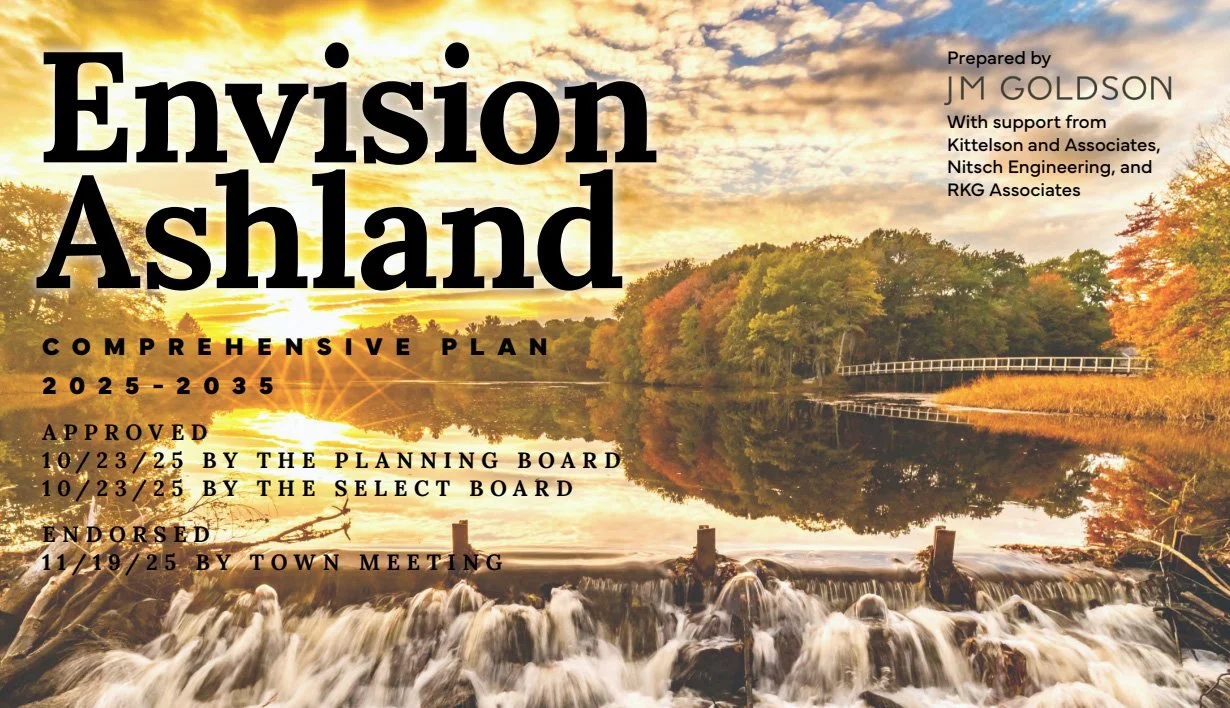
The Ashland Comprehensive Plan, titled Envision Ashland, addresses this complexity head-on. Its vision statement describes a community that “embraces our diversity, innovation, and history to responsibly grow and sustain a vibrant and resilient community.” That idea of responsible growth threads through every chapter of the plan.
The town’s five interconnected core themes reflect Ashland’s priorities:
Building and Enhancing Community
Promoting Long-Term Sustainability
Guiding Development that Honors Open Space and Conservation
Enhancing Town Services and Economic Development
Creating a Connected and Accessible Community
Together, these themes capture the tension and opportunity facing Ashland today: how to welcome new residents, support economic vitality, and create vibrant, walkable places, while also protecting cherished open spaces, responding to climate risks, and preserving the feel and fabric of the town.
In particular, the plan places significant emphasis on conservation and sustainability. Nearly half of Ashland’s land is open space, though only 25 percent is permanently protected. The town has committed to net-zero emissions by 2040, and residents prioritized strategies for expanding the tree canopy, increasing access to green infrastructure, and supporting sustainable housing and transportation choices. The plan also directly addresses housing affordability and diversity, recognizing that zoning and land use reforms will be needed to meet future needs.
The level of community engagement in Ashland was exceptional. We collected 3,487 participation points, surpassing our goal by 123 percent. These included over 1,400 survey responses, nearly 850 interactive crowdmap submissions, and more than 400 participants in in-person and small-group activities like meetings-in-a-box. The town’s Comprehensive Plan Committee, which included 29 residents representing a wide range of boards and community groups, played a pivotal role in outreach and deliberation. Their leadership made this plan stronger at every turn.
One resident summed it up perfectly during a community forum: “We’ve been having these conversations for years, but this plan makes it real. It shows that we are not only listening to each other but actually building something from it.”
Stow: A Legacy of Stewardship with an Eye Toward Inclusion
Just a short drive away, the Town of Stow offered an entirely different context and a completely different planning journey.
With a population of approximately 7,100, Stow is a small, largely residential town best known for its orchards, farms, and expansive conservation lands. Public transit is limited, with no MBTA service, and while Stow is within commuting distance of Boston, it retains a quiet, rural rhythm that residents deeply value. Roughly 28 percent of the town’s land is permanently protected, and the town has long invested in stewardship of its natural and cultural resources.
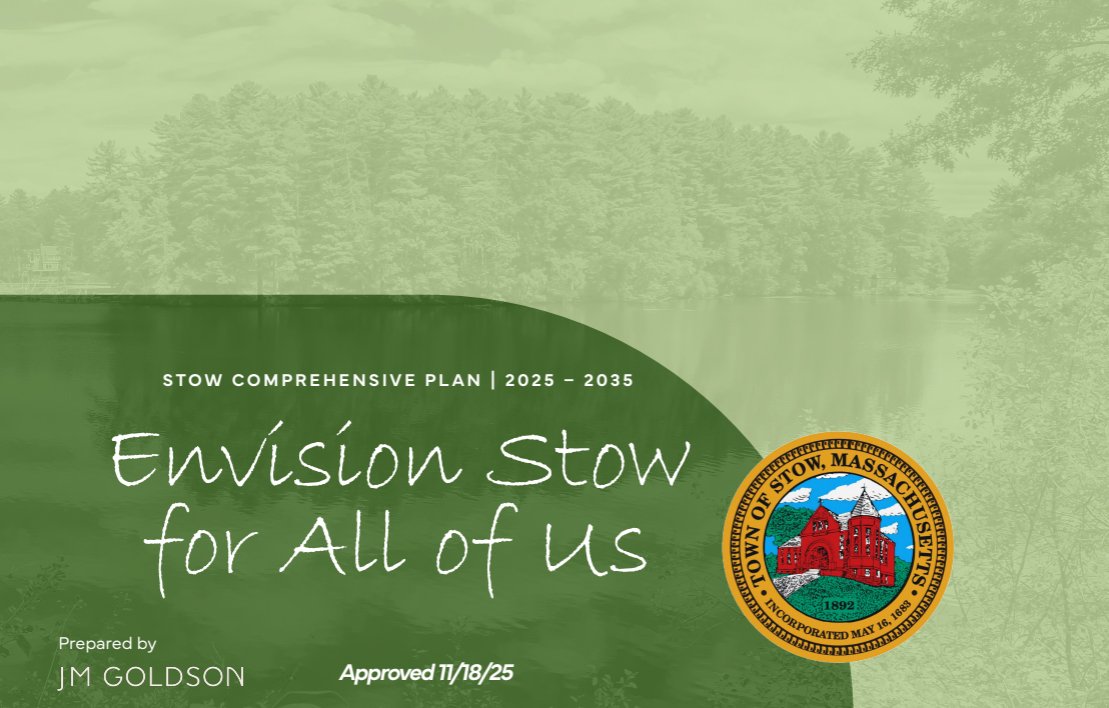
That stewardship ethic was a guiding force in Stow’s plan, Envision Stow for All of Us. The plan’s vision statement reads: “Stow will be known as a welcoming and inclusive town with active village centers, flourishing local businesses and farms, accessible public recreation lands and trails, and protected natural spaces and biodiverse habitats.” It also acknowledges the challenges of the present, noting that “the Town will proactively transform housing and transportation to ensure that they are affordable, livable, diverse, safe, healthy, and resilient.”
While preservation is a core theme, this plan is also forward-looking and inclusive. Stow is experiencing subtle but important demographic shifts, including an aging population and increasing diversity. Housing costs are rising sharply, and the town’s zoning has historically allowed for limited housing types. This plan charts a course for modest, place-sensitive growth, especially in and around village centers, and encourages regulatory reforms to expand housing choices while protecting farmland and open space.
The five core themes of the Stow plan are:
Balancing Priorities
Fostering Inclusivity, Participation, & Opportunity
Enhancing a Livable Community
Expanding Transportation Options
Building Community Resilience
These themes reflect both continuity and change, honoring what has made Stow special while planning carefully for a future that welcomes new neighbors, adapts to environmental change, and supports long-term sustainability.
Community engagement was again a standout success. The project generated 1,491 participation points, reaching 139 percent of our engagement goal. These included nearly 700 survey responses, over 250 interactive map contributions, and significant turnout at open houses, technical working sessions, and local outreach events. The Stow Comprehensive Plan Committee led outreach efforts and ensured that input reflected a range of perspectives.
A longtime resident shared this reflection during a small group session: “Stow is changing, and we need to be ready. I think this plan gives us a chance to stay true to ourselves while still making room for others.”
Common Threads, Distinct Stories
What connected these two plans was more than just a timeline. Both processes reflected a strong commitment to inclusion, sustainability, and intentional growth. Both communities wrestled with similar questions, about how to grow in a way that preserves what they love, how to address housing needs without losing the feel of their town, and how to prepare for the environmental and demographic changes ahead.
But what makes each plan successful is how different they are. Each is deeply grounded in place. Ashland’s plan reflects a vibrant, growing town with regional connections and ambitious climate goals. Stow’s plan reflects a rural community proud of its agricultural and natural legacy, looking to build resilience while strengthening civic ties.
These are not one-size-fits-all documents. They are living guides rooted in community voices and values. They offer different answers to different challenges, and both are better because of the care and collaboration that shaped them.
A Closing Word
To the Towns of Ashland and Stow, thank you. Thank you for trusting us to help you imagine your future. Thank you for your time, your partnership, and your vision. And to our project manager Austin Smith, thank you for your steady leadership and for helping both towns navigate complex processes with clarity and care.
We couldn’t be prouder of the plans these communities created. And we’re excited to see where they go from here.
If your town is looking to deepen public engagement in planning or policymaking, we’re here to help. Our team specializes in designing creative, inclusive, and effective engagement strategies that go beyond the public forum. Whether you need to reach underrepresented voices, build trust, or navigate challenging conversations, we can help you create a process that brings people in and moves ideas forward. Let’s talk.

Get in touch with Jenn
I’D LOVE TO CONTINUE THE CONVERSATION.
LET’S STAY CONNECTED:
More Articles